Understanding the Apollo 13 mission requires an understanding of the historic events that led to the enthusiasm, and then apathy, towards NASA and its efforts in space.
The Space Race
The first piece of context to understand Apollo 13 is the space race of the 1960s. This “race” was a technological contest between the United States and the Soviet Union to see who had the upper hand in the Cold War. In October 1954, the International Council of Scientific Unions (now known as the International Council for Science), an international organization dedicated to international cooperation in the advancement of science, agreed “to launch a satellite during the IGY [International Geophysical Year] in order to be able to map the earth’s surface from above.” 1 This geophysical year was from July 1, 1957, and December 31, 1958. This timeframe happened to coincide with the height of Cold War tensions, as the United States and Soviet Union were engaged in a nuclear arms race to maintain a military edge over each other. On paper, both nations seemed capable of accomplishing this goal. Both did have capable missile programs that could easily be used for this project, but it was the Soviet Union that realized space was “the ideal racetrack in the cold war,”2 ,and could use this project as a front for their nuclear missile program. Meanwhile, the United States was far more lukewarm towards this project, underestimating the political prestige that could come with this. Due to this hesitancy, the Soviet Union leap-frogging the United States by launching Sputnik 1 on October 4, 1957. The shock that followed this resulted in a shift in priorities towards spaceflight, albeit at a slower pace. After some missteps in the final months of 1957, NASA was created in order to plan out and accomplish NASA’s goals. However, NASA’s approach of slow and steady placed them on the backfoot, as by the time President John F. Kennedey entered office, “The general opinion was that the United States had fallen behind in the space race and without a major effort it would now lose this race.” 3 On May 25, 1961, Kennedy challenged the United States to land a man on the moon and return him safely to the earth.” This challenge would set the stage for the rest of the 1960s, and “the image of ‘an American astronaut planting the United States’ flag,” 4 proved irresistible to pass up to the country.

Decline in Interest of NASA
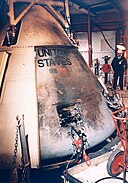
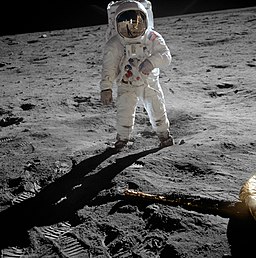
Throughout the 1960s, NASA pushed to complete Kennedey’s goal of landing on the moon through numerous test flights and proof-of-concept missions of processes and equipment necessary for a voyage to the moon. However, the road to the moon would be a rocky one. With the gunshot death of President Kennedy on November 22, 1963, was a blow to the “energetic form of political positivism,” 5 had little effect on NASA itself, but as the decade continued, more setbacks raised doubts. On January 27, 1967, the three crew members of Apollo 1, the intended first test flight of the program, perished in a flash fire during a simulated launch test, intensified by the pure-oxygen environment and flammable materials inside the cockpit. The shock of this tragedy brought with it questions of whether or not the cost in both financial and human life was worth it. However, NASA would make the necessary changes for safety, and with the successes of missions of Apollo 7 & 8 in 1968, the media had “not forgotten the spirit of the Apollo mission’s creation…but also…treated the mission as a major achievement of the Cold War.”6 With the success of Apollo 11, however, brought with it the rapid decline in interest in the program. NASA, like other government agencies, has their funding determined and granted by Congress. By 1970, the spirit of idealism and hope embodied by Kennedy had subsided, and Apollo was the “last glittering remnant of the past.”7 The rise of headlines in the news of violent clashes in the Civil Rights Movement, increased focus and broadcasting of the war in Vietnam, and a new presidential administration in the form of Richard Nixon, created an environment less enthusiastic towards committing $26 billion towards Apollo.



 Apollo 13 in Context